Racing Dial

I’ve been re-engineering the collection a bit over the last couple of weeks, and this lovely Speedmaster Mk II with a racing dial arrived this morning, having benefitted from a full service and a re-lap over at Watch Works in Bristol. I owned one of these a year or two ago, but that one had a replacement dial and handset; whilst it was photographic heaven I wasn’t happy with the fact that it wasn’t all-original any longer. Conversely, this one is absolutely perfect for me.

It wasn’t cheap but it’s such a nice example. Strangely – or perhaps not so – I got more comments and compliments when wearing the Mk II than with any other watch (I think it was a close thing with the Silverstone, but apart from those two my wristwear has gone largely unnoticed). I missed it a lot so I’m glad to add another, and anticipate wearing it a lot.

A couple of shots…

And now on a Di Modell Rallye with orange stitching…

Well, it had to happen…

I’ve been wondering what strap to wear on my Autavia GMT, and nearly tried the Di Modell a few months ago. Now, I wish I had because I really like it.

I’m sure there’ll be one or two dissenting purists’ voices calling for a Corfam, but I’m a big fan of the Rallye strap and won’t be changing it again any time soon.

Original Sinn

A few days ago, a member on TZ-UK posted a link to a rather rare and unusual Sinn that was listed on eBay by a jeweller/ watch dealer based in Essen, Germany. It was actually a Sinn 8820 diver, rare because they’re few in number and unusual because it was Sinn’s first titanium watch, preceding the 8829 when it was first released in (I think) 1995. The watch was causing a fair amount of interest – and admiration – but while all and sundry were singing its praises I decided to go one step further and buy it! In fact, it landed yesterday morning after lightning despatch and delivery.

I was a little confused when I first looked at it, largely due to the absence of “Swiss Made” on the dial and the numbers “12345” on the back. It transpires that the earliest samples released by Sinn had the sterile dial, but all of them bore the same sequence of numbers on the case back (which, I later realised, is not the serial number). The other striking thing about it is the recessed bezel, which allows a very slim case and what is an incredibly light and comfortable watch. The movement is an ETA 2892-A2, treated to a bit of decoration by Sinn prior to fitting, and the water resistance is 200m.

All in all, I think it’s a great watch – all the better, actually, for having a place in Sinn’s dive watch history. The only fault I can find with it is a little slackness when rotating the bezel, but that’s a minor gripe for a watch that looks as lovely as this (apologies – all the photos were handheld)…

The Datejust (revisited)

In the world of normal people (you know, the one’s who don’t pay ridiculous premiums for dive watches that can go to depths of 12000ft, when the deepest water they’ll ever see is the shallow end of a swimming pool)… in the world of such people, the Datejust is Rolex’s biggest selling watch by a country mile. I’ve been lucky enough have owned quite a few very nice vintage references – in fact, I thought I always would but after the last one went I found that I had absolutely no desire to replace it. In fact, it served to vindicate my decision to let it go. Funny that, I’ve never really been able to work out why I went off it, but I just did.

Anyway, I recently decided to give the new, larger (41mm) DJII a try and I was really blown away by the feeling of quality, the wrist presence and by the particular dial I had on mine (silver with baton markers). I was thrilled with it, but at the same time I thought it might be a little big for my wrist; however, once more the stars lined up for me and I managed to snag an as-new 116200 (that is, the new 36mm DJ) with virtually the same dial configuration; at the same time, I moved the DJII on to a friend, who I know will love it.

So, all is well with the world, in that I have a DJ again; and it’s both very classic and very contemporary at the same time. Good, that 🙂

Guest Post – Eddie Ardanza’s 1675

I’ve been chatting for awhile now with Eddie (who I know from Watchlords, one of the watch forums I pop into now and then) about a rather lovely GMT from the late 1960’s. When he offered to write a post about it I was delighted to oblige 🙂

This particular 1675 “landed” on my wrist when I inherited it from my late Father-In-Law; it’s a late ’60s GMT Master 1675, housing the great 1575 movement. Whist in all-original condition it was in a poor state aesthetically and also had an issue with the setting lever. The watch was actually kept unused in a safe for a number of years and, of course, was lacking any kind of attention (or, indeed, a service).

I had the watch packed and ready to send to Rolex Service (in Dallas, Texas) when I had an epiphany of sorts and dropped Tony a note [*good move*], in doing so saving the watch from potentially being butchered by the wise guys at the Rolex Service Center.

Admittedly, my vintage Rolex restoration knowledge is full of voids …enter Tony, who basically guided me through the process on what was desirable to leave as-is and what needed help, and he recommended ABC Watchwerks in Los Angeles, California… the results are all credited to his advice and expertise [*happy to help, mate*]. Summarising, the movement was service/overhauled including renewal of the mainspring & gaskets, replacement of the faulty setting lever, pressure testing to original specs and – finally – regulation to COSC specs. Aesthetically, a new plexiglass crystal was installed and both the case and bracelet were sympathetically refinished, in a “light vintage fashion”.

And here’s the result, now on my wrist and enjoying a new lease of life more than 40 years after it left the Rolex factory!

I think that’s a great story, and anyone who takes the time and trouble to bring an old classic back into daily service deserves to be applauded. Nice one, Eddie!

Sea-Dweller love

I admit that I’m in love with the Sea-Dweller in all it’s guises – my only sadness is that I had to let the Triple 6 go to fund the Great White.

Polar!

I’ve looked for the right white/tritium dialled Explorer II for a long time!

The Striking 10th

I was just looking – purely by chance – at an SOTC post from more than two years ago and couldn’t help but notice that despite all the changes since then I still have two of the watches featured at that time; one is the King of G’s (the JDM GW-5000) and the other is Zenith’s wonderful Striking 10th.

I’m not sure that the 10th is the most practical watch from a functional perspective, and personally find a regular tachymeter a little more useful. However, from a technical standpoint it’s a wonderful example of watchmaking, and the movement is of course quite beautiful. Mind you, the dial’s not too shabby either!

Just when you thought it was safe…

Well, I’m certainly happy this morning – after all the chopping and changing of late, the ins and outs have come to an end for now with a watch arrival that resolves one of my more painful regrets over the last couple of years.

The “Great White” Sea Dweller was released in 1977, and achieved it’s monicker as a consequence of Rolex’s decision to do away with the red font on the DRSD and replace it with… well, white. Also gone was the reference to the Submariner on the dial and the engraving on the case back was changed slightly. However, to my knowledge the same case was used and of course they came with the wonderful Tropic 39 Superdome crystal.

This one dates to 1980, and has a NOS crystal to set off the flawless dial (a Mark II, identifiable from the italic “ft” and “m” and the closed 6). The case is in great shape with fat lugs and sharp bevels, and the only think it could do with is an insert change as it’s wearing a service replacement. In fact, I’ve already bought a ghost insert for it, which should give the watch a pretty unique appearance.

I’m absolutely thrilled with this – my last Great White was a beauty but I actually think this one is even nicer. It’s pretty obvious that I’ve moved away from vintage Rolex sports watches for now, but to my mind the 1665 is the greatest watch that Rolex have ever produced and the opportunity to acquire another was irresistible.

Struck by lightning

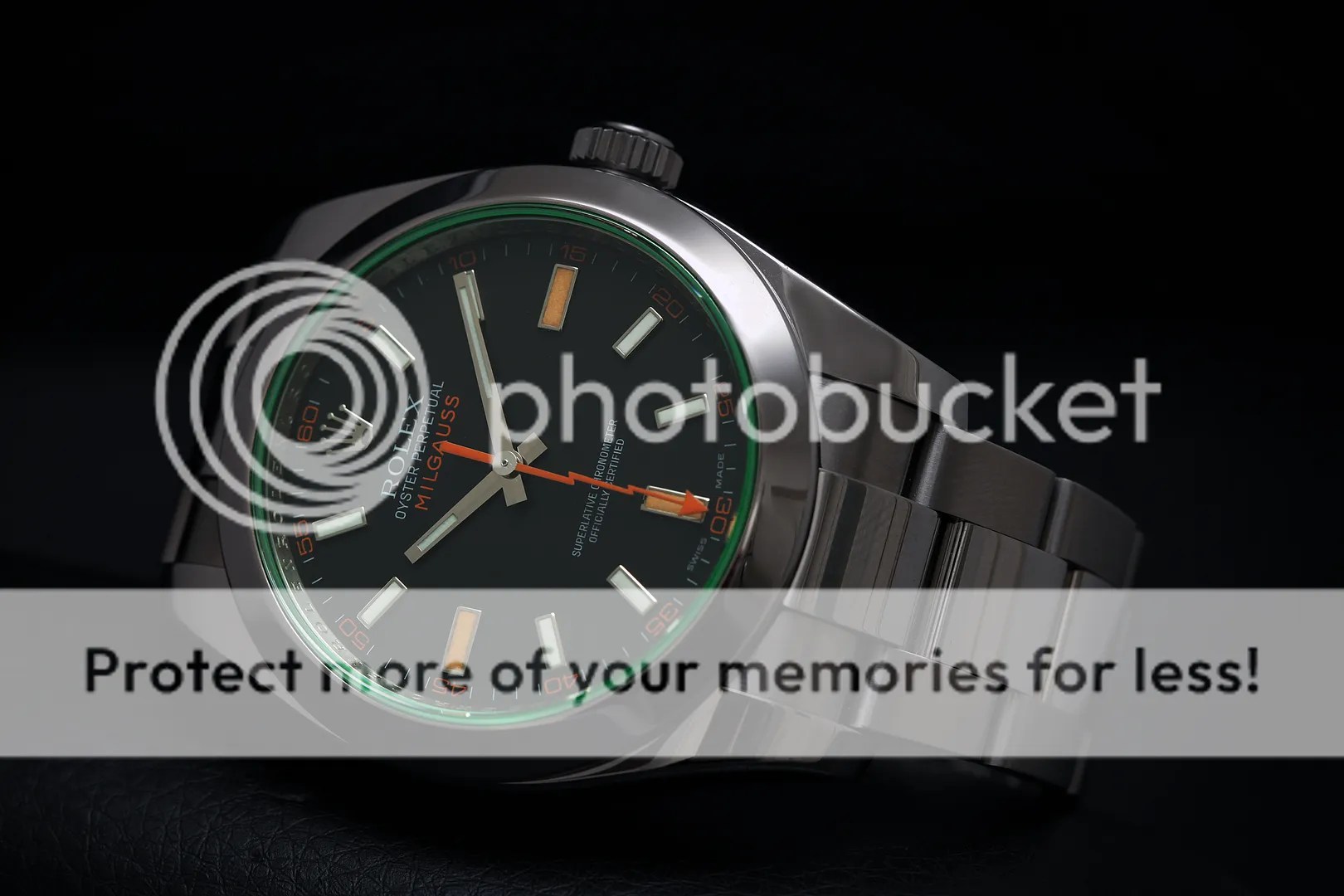
The Milgauss is one of the more interesting watches in the Rolex line-up, and also one of the most underestimated. It’s history goes back some 60 years, when (according to some sources) Rolex was commissioned by CERN to produce a watch that could be safely worn by scientists that were working in the field of electromagnetic technology (see what I did there?) – something that was becoming increasingly commonplace. Now, the problem was that mechanical watches are regulated by a balance wheel and hairspring, and magnetic fields don’t do them any favours. In fact, a watch that’s been subjected to a magnetic field will often run too fast or too slow; in fact, if the force is strong enough, it’ll likely stop running altogether.

Rolex’s answer to this problem was the original Milgauss, released in 1954 at much the same time as IWC released the first Ingenieur – another watch designed with antimagnetic properties. Both utilised a Faraday Cage to enclose the movement, the idea being that it would divert a magnetic field and protect the environment inside it (which included the balance wheel and hairspring). In fact, the name “Milgauss” is derived from the French word mille (meaning 1,000) and gauss (the unit of meaurement for the strength of magnetic fields), and the Milgauss was able to withstand fields of up to 1000 gauss.

The early models were not particularly popular, and production actually ceased in 1988. However, the line-up included one watch that is now a vintage classic – the 1019, which these days can go for upwards of £20k in decent condition…

As well as the original 6451 (check out the lightning-bolt second hand… look familiar?)

So, fast forward a few decades and we come to the current line-up – three models of quite different appearance but all featuring the same technology. Inside is a calibre 3131 movement that’s unique to this model (and which is essentially a thinner version of the 3130); a Blu Parachrom hairspring which is completely resilient to magnetic interference; and a Faraday Cage/inner case back – just to make absolutely sure of it’s antimagnetic capabilities. Aside from that, though, it really is a quite beautifully engineered watch, with a fit and finish that puts some of the other models to shame. It’s heavy too – heavier even than the Sea dweller, whilst still being supremely comfortable on the wrist.

The reason that I’m wittering on about the Milgauss is actually because I picked one up today; not quite on impulse as I’ve been looking at them for a while now (and made a couple of unsuccessful attempts to buy one previously). It somehow manages to be both sporty and dressy at the same time, and the GV (with a green-tinted crystal) as also unusual enough that you won’t see anything else even vaguely similar. I’m really happy with it, especially as this one came unworn and fully-stickered as genuine NOS. Anyway, here’s a few shots taken very quickly when I got home this afternoon, and before I popped out again for dinner. I’ll take some more at some point with a little more care and attention to lighting, but I think these give a pretty good impression of just how nice a watch it is. Oh, and you’ll see that it also has an engraved case back – the only Rolex aside from the Sea Dweller to do so.