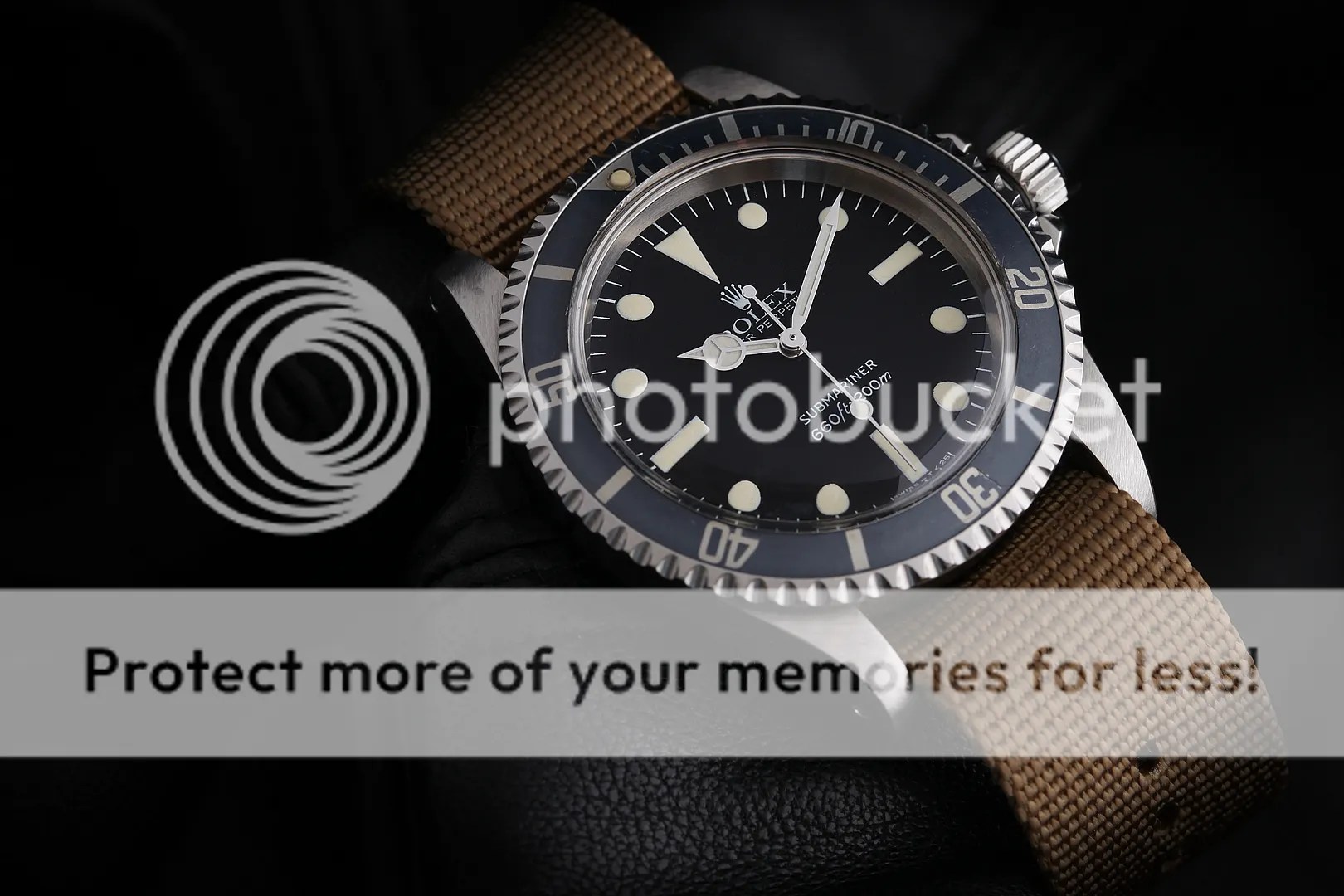
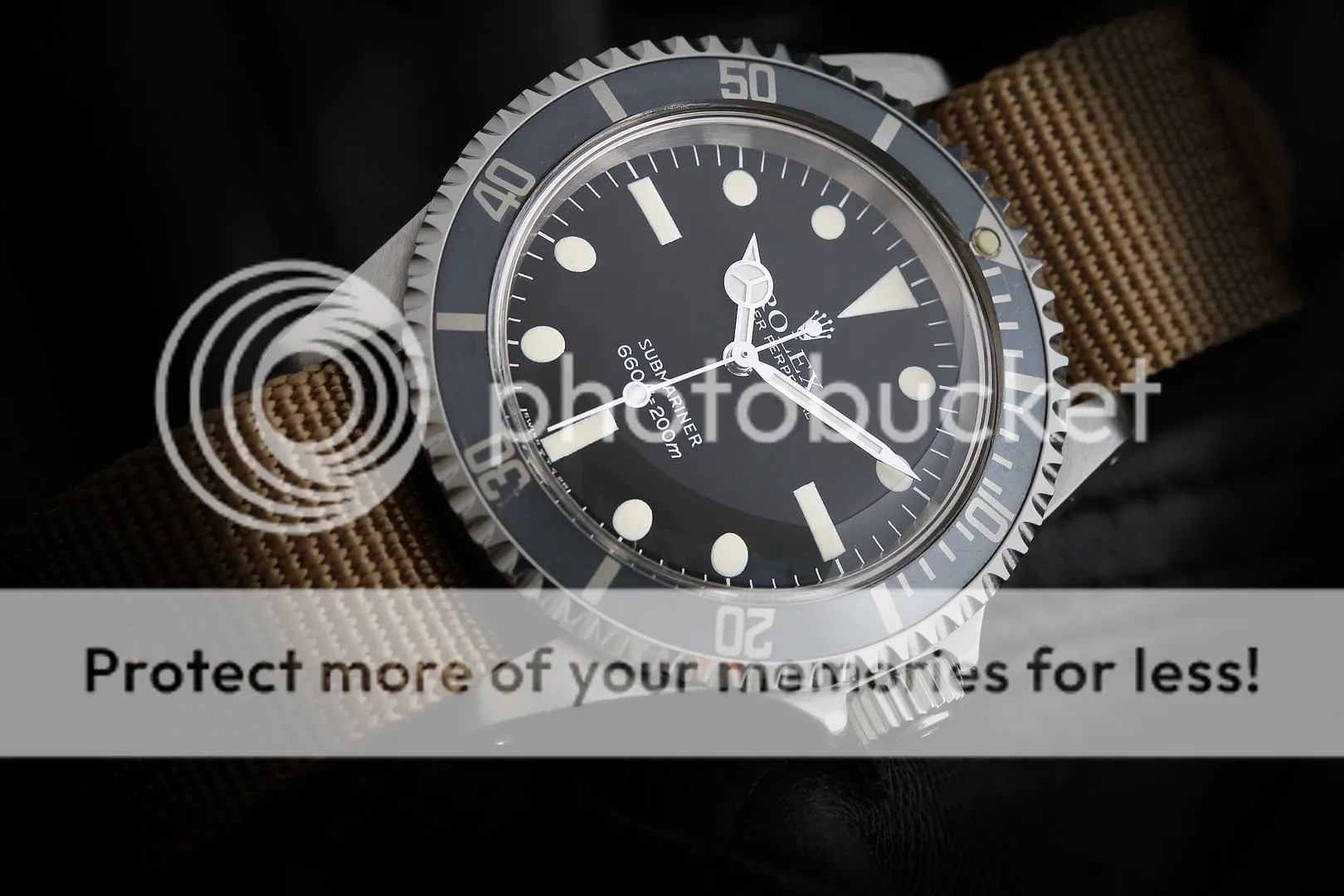
Return of the 5513

Not too long ago I was rejoicing the absence of divers in my now relatively small collection, having just moved on my second Great White in favour of a white gold Zenith Daytona. In fact, in the past I’ve had two of those beauties as well as two of the nicest 5513s that I’ve ever seen, not to mention a near perfect 1680. I suppose I’ve enjoyed something of a love affair with vintage Rolex divers and for some reason I’d decided that it needed to come to an end; in part, I suspect it was because I was a bit uncomfortable having so much money invested in a tool watch (at least, so far as the 1665s were concerned) which then made me worried about wearing them in all but the safest environments.

Anyway the upshot was that I tried to buy back my last 5513, unsuccessfully it transpired, and then set my sights on finding another really good example. At the same time, a TZ-UK member with whom I’d dealt before dropped me an email asking if I’d be prepared to let him have the Daytona and suggesting that I might want – you’ve guessed it – his 5513 in part trade. Well, a long exchange of emails transpired, but finally we got to the position where a deal could be done; yesterday, after a long wait, my 5513 arrived.

This watch dates from 1981, and benefits from a NOS Tropic 19 Superdome crystal as well as a period-correct NOS 93150 bracelet. The dial is perfect, with gorgeous lemon-coloured plots and the hands are absolutely free of any corrosion (the flash makes them look a little bit lighter than the plots but in reality they’re a perfect match in terms of colour). It’s actually a Mark IV maxi dial, for anyone interested. Aside from the serial range being a pointer it’s recognisable by the sans serif font, the size and position of the plots and the relative positioning of the bottom text (and specifically the “=” symbol). It also has a beautifully faded fat font insert, which whilst being a little early to be absolutely correct for the watch gives it an appearance that I think is quite sublime. Aside from that, it has a really fat case and lugs, which means I don’t have to worry too much if it picks up some marks and consequently needs a tart-up at some point in the future.

Anyway, I’ve now reverted to my two non-Rolex dressier watches in the JLC and the GO, and certainly won’t be making the error of moving the 5513 on again in the future. If once is careless and twice is foolhardy, three times would be downright stupidity.

Iconic chronographs

I’ve seen quite a few attempts to define the most iconic chronographs of all time. Top 5 after top 5, all of which have one thing in common… and that’s the watches that occupy the first 3 places. I didn’t set out to have those 3 in my watch box, but I’m not complaining either.

I have to admit, after these three it all gets a bit confusing. I think I’d go for a Heuer of some sort – probably a Monaco, put perhaps a Carrera – in 4th spot?

And then there were none…

I was chatting to a friend the other day, saying that I really seem to have “grown out” of divers. I don’t mean that in a condescending way, and there are some beautiful dive watches around, both old and new (and both Rolex and non-Rolex). Without meaning to, though, I seem to have slowly divested myself of them, and my other sports-style watches, in favour of alternatives that are a bit more dressy, or a bit more complicated. For me, this appears also to mean a bit more interesting.

I won’t dwell on those that have gone (there were many) or why I bought them (they were all beautiful, and most had some kind or heritage or, indeed, a status bordering on iconic). The last diver I had was a genuinely stunning Great White, but in the end I allowed it to go the way of the others. I know that many people will think that I’m completely bonkers, but there’s no point building a small collection of watches based on the views of other people. What works for me these days is a little different, and I’d like to think that – in ploughing my own furrow to some extent – I’ve also broadened my horizons a bit. Anyway, onto… the Daytona!

This is a watch that I’ve tried before, both times the modern variant in stainless steel and with a black dial. I was sadly underwhelmed on each occasion, though, and there were a few reasons why. Firstly, the silver on black dial layout was a bit bland to my eye; in certain light it was difficult to read, and the subdials tended to get “lost” such that nothing stood out particularly vividly. Secondly, they wear surprisingly small on the wrist; you’d think the opposite would be the case but they’re pretty slim/flat and seem to have a look and feel that suggests a size less than their 40mm. Finally, I couldn’t help feeling that the Zenith Daytona was the one to go for (well, if one ignores the earlier Valjoux 72 for obvious reasons). I know that the 4130 movement is a masterpiece in its own right, and that the Zenith calibre 400 was heavily modified. In fact, the changes effected by Rolex included some fairly major stuff. For example:
– A new escapement with a much larger, freely sprung balance and balance spring with Breguet overcoil – a preferred, and more costly configuration that leads to higher accuracy.
– A reduction in the balance’s oscillation rate from a speedy 36,000 bph to a more relaxed 28,800 bph – theoretically at least requiring less frequent service.
– Elimination of the date function.

In all, I think I’m right in saying that more than 50% of the individual movement parts were changed/upgraded in some way, so the final product was pretty different to the movement Zenith originally manufactured all the way back in 1969. When all’s said and done, however, I personally find the attraction of the Zenith Daytona outweighs any arguments in favour of the alternative. I’m quirky like that 🙂

Anyway, the history of the Daytona is a complicated one that goes back to 1965, when the name was used on the Cosmograph for the first time (it’s roots go further back than that, in fact). To try to address that history here would no doubt bore the socks off everyone but there’s plenty of info on the Net (and some good stuff over at Jakes Rolex World and Hodinkee amongst other places).

The one that’s sitting on my wrist at the moment is a white gold 16519 that dates back to 1998. The use of gold, as opposed to stainless steel, transforms the watch into an altogether different beast; the heft, the hue of the gold… both give it a wrist presence that I missed in the SS versions that I previously owned. The biggest difference is on the dial, though; it really does pop, and the appearance changes in different light and at different angles to an extent that’s hard to believe. Hopefully, I’ve demonstrated that to some extent in the photos below.

So, do I miss my divers? Errrr, no – not right now, I don’t!

More DB10s…

I picked up a few DB10 straps recently, and they arrived in the post today. I’ve wanted suede for my Great White for a while now, and I reckon it looks the dog’s.

I can’t remember…

When I only had 6 watches (well 7 really, but one is at service and will be moved on when it’s back). It’s very… liberating.

Loving the tan as we got into the summer sunshine too 🙂

Pairs

Bizarre – I didn’t even realise it was happening 🙂

Man of steel

No, I’m not talking about the new Superman movie. However, whilst I’m normally whipping off bracelets before the watches are even out of the box, I just couldn’t find the perfect match for this tritium Explorer II so – in a moment of inspiration – I put it back on the bracelet.

Nice!

The Datejust (revisited)

In the world of normal people (you know, the one’s who don’t pay ridiculous premiums for dive watches that can go to depths of 12000ft, when the deepest water they’ll ever see is the shallow end of a swimming pool)… in the world of such people, the Datejust is Rolex’s biggest selling watch by a country mile. I’ve been lucky enough have owned quite a few very nice vintage references – in fact, I thought I always would but after the last one went I found that I had absolutely no desire to replace it. In fact, it served to vindicate my decision to let it go. Funny that, I’ve never really been able to work out why I went off it, but I just did.

Anyway, I recently decided to give the new, larger (41mm) DJII a try and I was really blown away by the feeling of quality, the wrist presence and by the particular dial I had on mine (silver with baton markers). I was thrilled with it, but at the same time I thought it might be a little big for my wrist; however, once more the stars lined up for me and I managed to snag an as-new 116200 (that is, the new 36mm DJ) with virtually the same dial configuration; at the same time, I moved the DJII on to a friend, who I know will love it.

So, all is well with the world, in that I have a DJ again; and it’s both very classic and very contemporary at the same time. Good, that 🙂

Guest Post – Eddie Ardanza’s 1675

I’ve been chatting for awhile now with Eddie (who I know from Watchlords, one of the watch forums I pop into now and then) about a rather lovely GMT from the late 1960’s. When he offered to write a post about it I was delighted to oblige 🙂

This particular 1675 “landed” on my wrist when I inherited it from my late Father-In-Law; it’s a late ’60s GMT Master 1675, housing the great 1575 movement. Whist in all-original condition it was in a poor state aesthetically and also had an issue with the setting lever. The watch was actually kept unused in a safe for a number of years and, of course, was lacking any kind of attention (or, indeed, a service).

I had the watch packed and ready to send to Rolex Service (in Dallas, Texas) when I had an epiphany of sorts and dropped Tony a note [*good move*], in doing so saving the watch from potentially being butchered by the wise guys at the Rolex Service Center.

Admittedly, my vintage Rolex restoration knowledge is full of voids …enter Tony, who basically guided me through the process on what was desirable to leave as-is and what needed help, and he recommended ABC Watchwerks in Los Angeles, California… the results are all credited to his advice and expertise [*happy to help, mate*]. Summarising, the movement was service/overhauled including renewal of the mainspring & gaskets, replacement of the faulty setting lever, pressure testing to original specs and – finally – regulation to COSC specs. Aesthetically, a new plexiglass crystal was installed and both the case and bracelet were sympathetically refinished, in a “light vintage fashion”.

And here’s the result, now on my wrist and enjoying a new lease of life more than 40 years after it left the Rolex factory!

I think that’s a great story, and anyone who takes the time and trouble to bring an old classic back into daily service deserves to be applauded. Nice one, Eddie!

Sea-Dweller love

I admit that I’m in love with the Sea-Dweller in all it’s guises – my only sadness is that I had to let the Triple 6 go to fund the Great White.