Horological heaven

It’s been a rather painful couple of weeks for me, if truth be told. I’d been a bit extravagant with regard to cameras and god knows what accessories of late, and then had my head turned by a car that I hadn’t planned on buying. A couple of watch sales that were intended to raise funds became trades instead, and the upshot is that I’ve gone down from 16 to 11 watches in quite a short space of time. Indeed, some of those that have gone have been quite delectable vintage pieces, but in truth I’ve been a little bored with Rolex – and with sports watches – for a while now. However, a constant craving – to quote Ms Laing – for months now has been a Reverso, and I’ve tried many on, met a few WIS to either window shop or consider buying a specific model and have mulled over the various sizes that JLC offer before finally making a decision. And it wasn’t even a decision that I’d have predicted, but more on that in a second…

I’ve written about the history of the Reverso before, but for those that aren’t familiar with it the story goes all the way back to the winter of 1930/31. Cesar de Trey – a swiss businessman – attended a British Army polo match where one of the officers had broken the crystal of his watch whilst playing. Trey was challenged to find a solution to this problem and having come up with an idea in terms of case design then came to an agreement with Jaques-David LeCoultre, who would provide the movement. LeCoultre commissioned Jaeger SA to build the case, and the Reverso was born officially in 1931.

Some digging around reveals the original patent drawings…
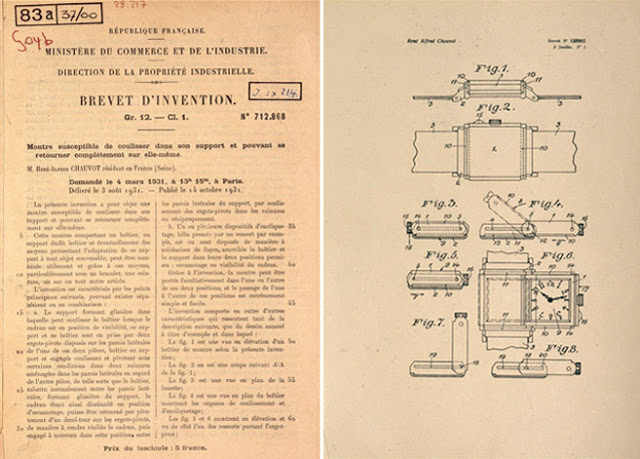
And, of course, the first Reverso to be made available (which has even now taken on the guise of the Tribute to 1931, which I’ve tried on and is gorgeous)… 38mm long, 24mm wide and just 6mm high, the same size as today’s Reverso Classique.

The watch became an immediate success, heralded not only for its quality but for the innovation in its design…


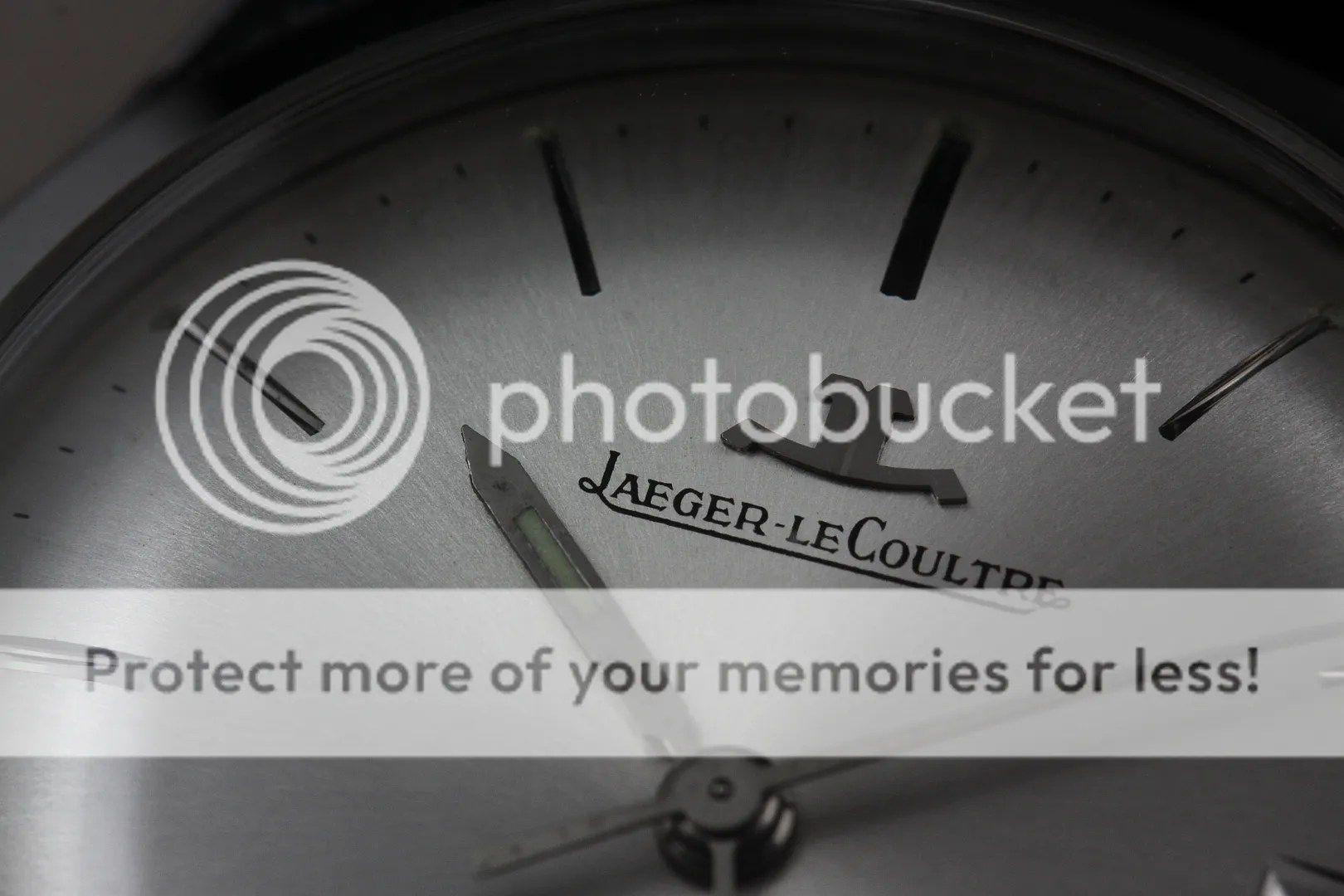
So, fast forward a mere 82 years, and the postman’s ring of the doorbell this morning bought something of a long chase to a rather wonderful end. I now have a Reverso Grande Sun Moon on my wrist as I type this post; it’s far more beautiful than I can adequately articulate, but hopefully the photos below do it just the slightest bit of justice in this respect. Guilloche dial, blued hands and a power reserve indicator in the top left corner – but the really breathtaking elements are the day/night indicator at top right and the moonphase with sub-seconds at bottom right. Somehow, with all that going on, the dial still seems beautifully balanced – a work of art, really.

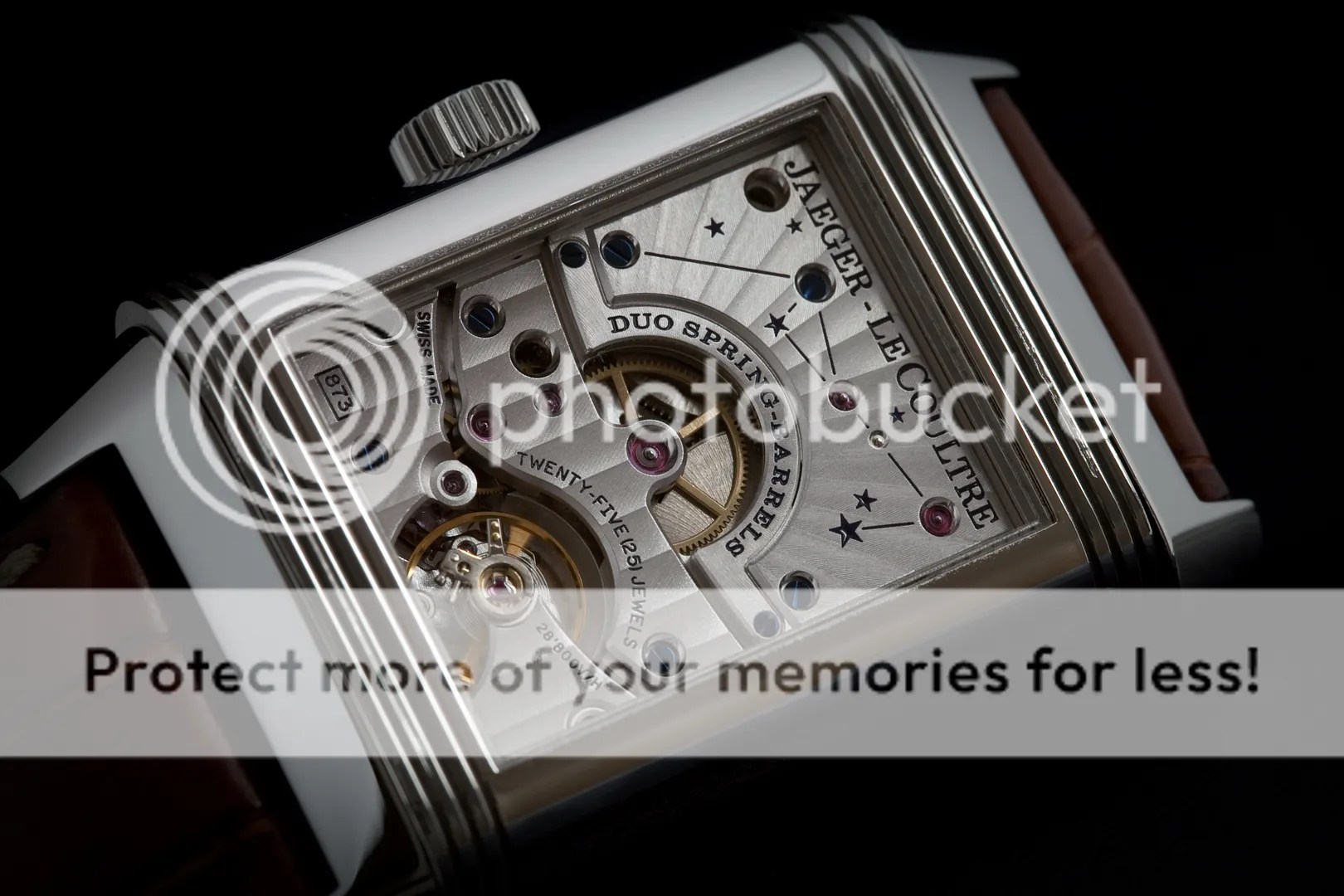
The real wonder, though, is revealed when the watch is flipped over to show what can only be described as one of the most magnificent movements through the display back. The JLC calibre 873 is a handwound movement providing an incredible 8-day power reserve in what is a quite miraculous twin barrelled design. It consists of 213 parts and contains 25 jewels, all combining to beat at 28,800 vph. As if that’s not enough, the hand decoration is quite sublime, from the Cotes de Geneve stripes to the constellation of stars formed by the rubies and blued screws. In other words, a mirroring of the themes on the dial on the movement itself.

It’s probably obvious that I’m thrilled with this watch, and as I reduce the numbers even more over coming months I’m quite sure that it will see more wrist time than most. For now, though, all I can do is try in some way to demonstrate what I’ve been rambling on about. Hope you like the photos!

28th February =

Perpetual Calendar Day!

The “other” JLC

I forgot just how perfect the RDM really is.

Perpetual

Life can be…

Dial

As good as it gets?

Long post warning!

Complications. They seem to divide opinion to a certain extent, in as much as some of us love them whereas others prefer the simplicity of a more basic mechanism and, consequently, dial. For me, it’s been a strange morphing of taste over the last year or so although I have to admit that my interests seem to be rooted firmly in two camps. (Well, why does a liking for simplicity or complexity have to be mutually exclusive?)

I’ve owned a JLC Reserve de Marche for quite a while now, and it really is one of the most perfect of watches. Whilst the dial has a fair amount going on the overall appearance is one of simplicity. Ironically, I thought that it was pretty much the limit for me when I bought it but before very long I realised that – if anything – I hadn’t gone far enough, and I was soon mulling over various options for even more complication, particularly the strangely alluring moonphase. In fact, the mulling soon became a yearning; I’d been looking at vintage options (such as the Universal Geneve Tri-Compax) for quite some time – months, in fact – but I ended up firstly with a Seiko Spring Drive Moonphase and then a GO Senator Lunar Reserve de Marche. (As an aside, the moonphase is the strangest of complications, isn’t it? No use whatsoever, but so beautiful.)

Both were fine watches, but for some reason neither seemed to feel like they were “one” I was looking for, and it slowly dawned on me that the watches I was continuously salivating over were those that really seemed to push the watchmakers art closer to the boundary. In fact, what I really wanted was a Perpetual Calendar; specifically, the JLC Master Perpetual that was discontinued quite a few years ago now but which – at 37mm – was a far better size in my eyes than it’s larger replacement (the current 8 Day Perpetual).

I went as far as to post about the watch quite a few times on various forums over the months, particularly when chewing the (two or three-dimensional) fat with the like-minded friends, but to be entirely honest I had far from made up my mind that I was actually going to buy one any time soon. Then a few wheels seemed to turn in the horological universe such that circumstances presented me with the opportunity that I’d been (almost) waiting for. Today, as a result, a JLC Master Perpetual Calendar in rose gold arrived as promised and I can finally say that I have a watch that leaves me without any further desire, for anything. Well…

The movement is the Jaeger LeCoultre Calibre 889/440/2, which dates back to 1996. It’s actually the JLC 889/2 base movement, with then utilises the design of the IWC perpetual calendar plate made famous by that company in the Da Vinci (although from what I understand the movement in it’s entirety, including the calendar plate, is manufactured by JLC).

It’s a 28,800bph automatic movement, with 50 jewels, and 277 parts. Like all movements used in the JLC Master Control series, it’s been subjected (as a completely finished watch) to 1000 hours of rigorous reliability testing in 6 positions, over a temperature range of 4->40 Celsius. Testing includes magnetism (5000 amperes/meter), shock, vibration, and pressure (5 atm) tests.

In terms of functions, there really is quite a lot going on.

  • Hours, minutes and centre sweep second hand
  • Date, month and day of week each on separate recessed sub-dial, with blued hands.
  • Two digit year display, via a window within the month sub-dial
  • Moon phase (yes, you may well ask why, and there’s no answer other than “because”)
  • A warning indicator, just below the month sub-dial, which shows red during the time period (10pm->3am) when it’s unsafe to set back the time, or adjust the date. (The hands even have cut-outs in them so that the indicator is visible at all times.)
  • One pusher, which adjusts (in a single operation) the entire calendar (date/day/moon phase/month/year simultaneously) one day forward per push.
  • With regard to that latter point, I think this is known as a “locked” calendar mechanism, and the alternative isn’t something that would be particularly user-friendly. However, the calendar can’t be turned backwards; this means that if you were to inadvertently set it ahead of the current date all you can do is let it wind down until time has caught up with the representation of time… (that was just for you, Cilla).

    The case is simply gorgeous, a warm, soft pink 18kt rose gold (the diameter 37.2mm, height 10.1mm). It has a very slightly domed crystal and solid case back, which is attached to the case with 4 screws. This beautiful watch was also available in stainless steel, yellow gold and platinum and to my knowledge all provided the option of bracelet or alligator strap with appropriately matching deployant. (I have to ask, though, who on earth would wear this on anything other than leather?)

    Anyway, that’s about it. For me, it’s just the fulfillment of a bit of a dream, albeit a relatively recent one, and something I can’t imagine topping (or even thinking of topping), and suspect that I’ll be wearing this quite a lot. To put it mildly!

    Size isn’t everything

    This is such a lovely watch. At 37mm the size is spot on for something dressy, but it’s equally nice with jeans and a t-shirt. One of my all-time favourites.

    It’s… complicated

    Power reserve

    JLC Memovox Tribute to Deep Sea

    Time to get up

    I went out recently to have dinner with a good friend and her family. We were chatting after polishing off a rather nice dessert when she disappeared from the table, coming back a couple of minutes later with a small leather pouch in her hand. “Here you are, call it a wedding present”, she said.

    I took my present out of the pouch, and it turned out to be a 1950’s Jaeger LeCoultre Memovox travel clock, in a lovely stainless steel and brass case with a folding cover/stand. It has two signed JLC crowns and is about 37mm x 46mm in size. We tested the alarm, which functions perfectly, and it took just a couple of small winds for it to spring into life.

    The clock belonged to my friends father, who died in 1962. He’d had it for a few years by then, since which time it’s sat in a drawer, never being wound or used until now.

    A fitting tribute

    I nearly bought this watch months ago. I wasn’t quite at the point where I was ready to say yes back then, and instead went on a quest to find an original vintage from 1959 without success, and then any vintage Memovox in similar style. All came to nought (not many around and too expensive anyway) and a week or two ago I made the decision to try and land this one again – the Memovox Tribute to Deep Sea.

    Aside from the fact that I’m a massive JLC fan, I’ve admired this watch since its issue a year or so. Its been something of a long haul, but I got there in the end!

    Pronounced…

    “Zhey-Zher Lecooltr” (yep, really)

    A brace of…

    Dressy, sporty, lovely

    What time is it in…

    Classic, simple, vintage

    Aimez-vous une réserve de marche?

    1965 vintage

    This is a pick-up I’m very pleased with – a JLC from 1965, model reference E393. Its 35mm without the crown, has a glorious starburst dial, and a fantastic domed plexi to set it all off. It’s quadruple signed (dial, crown, case back and movement) and for me epitomises everything that I like about smaller, simple watches. The movement is a JLC calibre K881, and this is quite interesting in itself.

    The K881 was introduced in 1959 and was the first JLC movements to feature a centrally pivoted 360 degree rotor that wound in both directions. The K part of the calibre number was a reference to Kif Flektor, the form of shock protection mechanism used in this unit. The company had flirted with rotor design in 1951 with the superb calibre 493, this winding in only one direction, but JLC watches with this movement were only sold for a two year period and it wasn’t to be until 1959, when the E393 was released, that their automatics finally entered the modern age. Incidentally, a development of this calibre, the 888, is still manufactured by Jaeger LeCoultre today which is an indication of how significant, and how brilliantly engineered, these K881 movements were.

    One of the most obvious characteristics of the K881 is that, almost uniquely on a movement of this grade, it has no mechanism for fine adjustment. Astonishingly, the reason for this “omission” was that the K881 was manufactured as standard to such fine tolerances that it would achieve chronometer rated accuracy as a production norm, without the need for any further adjustment. The American publication “WatchTime” ran a test on the K881 and the various other related Jaeger LeCoultre movements from the same era in its August 2003 edition, concluding that this mechanism “embodies superlative expertise that emphasises skilful, precise craftsmanship and surface beauty”. Further mention is made that in its very slightly revised form, this same movement type was officially certified as a chronometer and sold in tiny quantities as the “Chronometre Geomatic”, a model that commands a lofty price today on account of its scarcity.

    So, beautiful both on the outside and within…