Those bloody Seikos…

I wrote some time ago about my addiction to old Seiko divers – particularly the 6309 – and as if to prove the poijt I’ve just bought back the actual watch featured in that post. It’s a 1979 6309-7049 (the latter numbers signifying that it was built for the US market) and it’s a peach.

I really must try to hang onto it this time 🙂

4th time lucky

Based on an over thirty year-old design, the Marine Master 300 (model reference SBDX001) is like taking a step back in Seiko history. The quality is supreme, starting with the monocoque case, heavy but comfortable. The movement is a 26 jewelled, 28,800 bph 8L35, an undecorated and unadjusted version of the high-end Grand Seiko 9S55. The dial is a rich and gorgeous matt black, with applied silver indices and Seiko’s magnificent Lumibrite fill on markers and hands.

This one is my 4th, and I’ve bought it again (for the last time) because I genuinely think it’s the best bulletproof, everyday watch that you can get for the money. The only fly in the ointment is that they still need to go back to Japan for servicing (although that situation may be changing any time now).

One of my all-time favourites

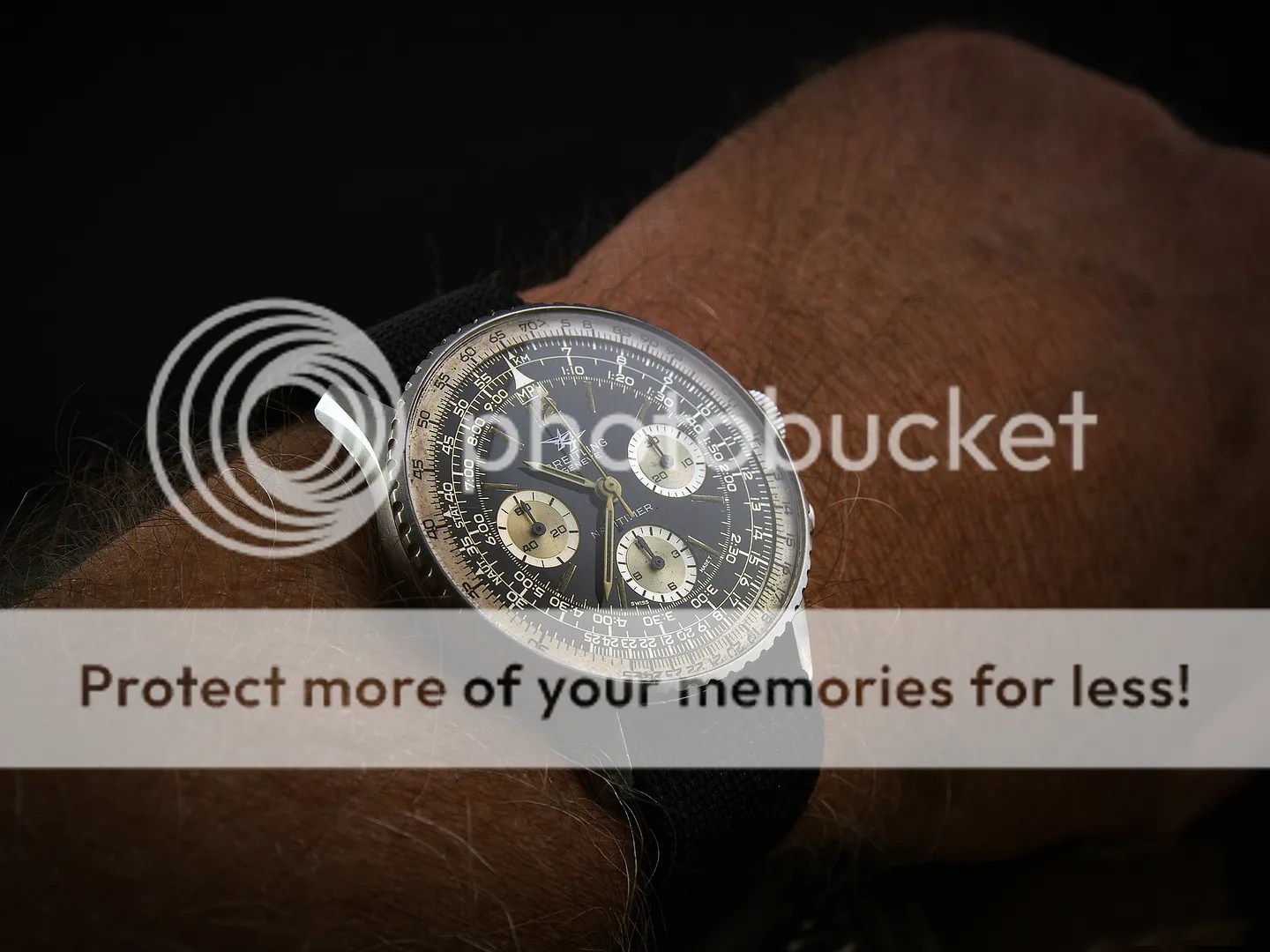
I’m not quite sure what it is about the 806 Navitimer. This is my second – once again housing a Venus 178 movement and showing far more patina than the first (but all the better for it); when on the wrist, it just has a delicious golden glow that hints at its 47 years of age.

I could honestly wear this every day and never get bored, and I don’t see myself ever selling it. A perfect watch, and one of my all-time favourites.

Dot over 90

I met a few fellow watch-enthusiasts for a (rained-out) BBQ over the weekend. Someone had kindly offered to bring a press in order that the old/original “dot over 90” bezel could be put back onto my Ed White Speedy and I thought it was too good an opportunity to pass up. Off came the service replacement and on went a rather worn, scuffed but authentic bezel in its place.

I do tend to like my watches as minty as possible, but for some reason this looks so much better.

Iconic chronographs

I’ve seen quite a few attempts to define the most iconic chronographs of all time. Top 5 after top 5, all of which have one thing in common… and that’s the watches that occupy the first 3 places. I didn’t set out to have those 3 in my watch box, but I’m not complaining either.

I have to admit, after these three it all gets a bit confusing. I think I’d go for a Heuer of some sort – probably a Monaco, put perhaps a Carrera – in 4th spot?

And then there were none…

I was chatting to a friend the other day, saying that I really seem to have “grown out” of divers. I don’t mean that in a condescending way, and there are some beautiful dive watches around, both old and new (and both Rolex and non-Rolex). Without meaning to, though, I seem to have slowly divested myself of them, and my other sports-style watches, in favour of alternatives that are a bit more dressy, or a bit more complicated. For me, this appears also to mean a bit more interesting.

I won’t dwell on those that have gone (there were many) or why I bought them (they were all beautiful, and most had some kind or heritage or, indeed, a status bordering on iconic). The last diver I had was a genuinely stunning Great White, but in the end I allowed it to go the way of the others. I know that many people will think that I’m completely bonkers, but there’s no point building a small collection of watches based on the views of other people. What works for me these days is a little different, and I’d like to think that – in ploughing my own furrow to some extent – I’ve also broadened my horizons a bit. Anyway, onto… the Daytona!

This is a watch that I’ve tried before, both times the modern variant in stainless steel and with a black dial. I was sadly underwhelmed on each occasion, though, and there were a few reasons why. Firstly, the silver on black dial layout was a bit bland to my eye; in certain light it was difficult to read, and the subdials tended to get “lost” such that nothing stood out particularly vividly. Secondly, they wear surprisingly small on the wrist; you’d think the opposite would be the case but they’re pretty slim/flat and seem to have a look and feel that suggests a size less than their 40mm. Finally, I couldn’t help feeling that the Zenith Daytona was the one to go for (well, if one ignores the earlier Valjoux 72 for obvious reasons). I know that the 4130 movement is a masterpiece in its own right, and that the Zenith calibre 400 was heavily modified. In fact, the changes effected by Rolex included some fairly major stuff. For example:
– A new escapement with a much larger, freely sprung balance and balance spring with Breguet overcoil – a preferred, and more costly configuration that leads to higher accuracy.
– A reduction in the balance’s oscillation rate from a speedy 36,000 bph to a more relaxed 28,800 bph – theoretically at least requiring less frequent service.
– Elimination of the date function.

In all, I think I’m right in saying that more than 50% of the individual movement parts were changed/upgraded in some way, so the final product was pretty different to the movement Zenith originally manufactured all the way back in 1969. When all’s said and done, however, I personally find the attraction of the Zenith Daytona outweighs any arguments in favour of the alternative. I’m quirky like that 🙂

Anyway, the history of the Daytona is a complicated one that goes back to 1965, when the name was used on the Cosmograph for the first time (it’s roots go further back than that, in fact). To try to address that history here would no doubt bore the socks off everyone but there’s plenty of info on the Net (and some good stuff over at Jakes Rolex World and Hodinkee amongst other places).

The one that’s sitting on my wrist at the moment is a white gold 16519 that dates back to 1998. The use of gold, as opposed to stainless steel, transforms the watch into an altogether different beast; the heft, the hue of the gold… both give it a wrist presence that I missed in the SS versions that I previously owned. The biggest difference is on the dial, though; it really does pop, and the appearance changes in different light and at different angles to an extent that’s hard to believe. Hopefully, I’ve demonstrated that to some extent in the photos below.

So, do I miss my divers? Errrr, no – not right now, I don’t!

Shell cordovan

This Autavia GMT is almost too perfect to wear… in fact, I hadn’t worn it for a while before I bought a new shell cordovan strap for it from DB10. Now, it would be rude not to.

Sometimes…

You just have to leave the dial alone!

Pre-pro, pre-moon

The definition of “icon”

Icon: a person or thing regarded as a representative symbol or as worthy of veneration (Oxford English Dictionary)

I find the general love of all things Breitling a bit mystifying, if I’m honest. Whilst I don’t doubt their quality for a moment, I really haven’t seen many that I like and most are simply far too blingy for an old fart/traditionalist like me. That said, there has always been one exception, and that’s the Navitimer. Within the iconic watch hierarchy I believe it holds a place very near the top, and some time ago I allowed a rather lovely example to slip through my fingers. yesterday, however, I put that right.

The Navitimer has a genuinely interesting heritage and history. After the great success of Breitling’s first slide-rule watch (the Chronomat), the Navitimer was launched all the way back in 1952. Whilst the Chronomat was focussed on the engineer and businessman market, the Navitimer was designed specifically for pilots; so much so that the “Aircraft Owners and Pilot Association” (AOPA) immediately decided to make it their official watch. This new Navitimer combined three essential tools for navigation – a watch, a chronograph and a slide-rule. It was, effectively, a navigation timer, hence the name it was given.

The Navitimer was designed with the Venus 178 movement (although some later models contained a Valjoux), a well-respected column wheel chronograph, and the first to be produced were fitted with a black Arabic dial and the famous AOPA logo. In fact, on the very first models “Breitling” was only seen on the case back. Shortly afterwards, the Breitling name was added over the AOPA logo, sometimes topped with the “B”. The reference of this watch was 806, and remained so until the introduction of a completely new generation in the 1970’s.

Over the following years, there were a number of dial variations, each termed a “Generation” (numbered 1-7 or so up to the 70’s, at least); there are some reasonably good sources of information out there for anyone who may be interested, but it takes a bit of legwork and it can be a little confusing as not all historic accounts are completely consistent.

Anyway, this acquisition is lovely – a 2nd Generation 806 that dates to 1966. It really is in good all-original condition, with a white on black dial and incorporating the earlier/smaller subdials that I think are by far the nicer. Aside from the fact that the case is largely unmarked, the patina on dial and hands is even and dark, and the subdials are gorgeous (it was very recently serviced, but a decision was made at the time not to attempt to clean the dial – there are obvious signs of discolouration, but on the plus side it means that it’s in untouched condition). Note the absence of red highlights too – seen on later/current models but unsubtle in comparison.

Just a little (more specific) information on the 2nd Generation variant, taken from the Net:

In approximately 1960 – after the watch had already become a huge success – the Navitimer’s design was modified and thereafter became known as “2nd generation”. The three subdials changed from black to white, the hands were remodelled and the Breitling name appeared in printing on the dial. During the 1960’s the slide-rule bezel was also remodelled twice. Moreover, the AOPA wing was removed from the dial and the official Breitling Navitimer logo became two aircrafts flying in close formation. At the same time, however, Breitling continued to supply AOPA with Navitimers sporting the AOPA logo on the dial.

It was quite hard to glean much data on the Venus 178, but I did find this:

Lever movement, stem wind, seconds bit with second hand, column wheel chronograph with carrying arm, 1/5 second, 30-minute register and hour counter. Diameter 31mm, 18.000 BPH, 17 jewels, Incabloc shock protection.

So, a few photos then…

Patina, anyone?

Levitation

A winner from Time Factors

I well remember my business trip to Sweden back in 2011 that saw me hooking up for lunch with a fellow WIS based in Stockholm. Carl and I had chatted on line for a while and it was good to meet him; what I hadn’t anticipated was that I’d leave the restaurant with two beautiful vintage watches from the 1970’s – the first an IWC Yacht Club, and the second a Seiko 6105 in near-perfect condition. Funnily enough, Apocalypse Now is possibly my all-time favourite film, so wearing the watch that adorned Captain Willard’s wrist felt kind of cool. Of course, it’s also just a cool watch.

Anyway, that was moved on at some point, but fast forward to last week and I was delighted to pick up Time Factors‘ latest offering – the Smiths PRS-68. It’s a wonderful watch that pays fitting tribute to the inspiration for it’s design. However, Eddie Platts (as always) ensured that there were a few improvements to the “original” specification and in this case that included:

Water resistance improved to 200 metres
Screw-down crown replaces bayonet locking crown
Sapphire crystal to replace original mineral crystal
Lug spacing increase to 20mm to enable a greater variety of straps to be fitted
Movement uprated to hi-beat (Miyota 9015)
Quality stainless steel bracelet with solid end links

One thing I particularly like about the TF watches is that the design details are made freely available on the website, and also become the subject of much debate on-forum until such time as the watches go into production. You can see the thinking behind the PRS-68 here but these are the drawings I referred to, from which you can see the level of detail that goes into the production process:

On the wrist, it’s a delight to wear. Whilst being true to the original in terms of overall design there are also marked differences, specifically on the dial; the Smiths logo and red “200 metres” reveal it’s origins quite clearly and – to me, at least – are perfectly proportioned. The surround on the indices is a little thicker than those on the 6015 and the lume (C3 Luminova, and very bright) a little greener. I’m not 100% sure what I think about the raised bezel pip but that’s a minor detail and not one that will keep anyone up at night. The sapphire crystal is flat and flush with the top of the bezel but is curved on the underside, with an AR coating that in some light gives it a blueish tinge. Legibility is excellent, and the look of the dial is clean and uncluttered. What I really love, though, is the second hand, with it’s red dot harking back to one of Seiko’s design triumphs.

It’s also very, very comfortable. The case is a tad larger than that of the 6105 at 44.5mm but is sits very flat, and with it’s very short lugs can be worn by those with relatively small wrists. Luckily the lug width has been increased to 20mm which means that strap choices abound (I’m wearing mine on black nylon, which seems a perfect match to my eyes). In fact, that additional 1mm between the lugs makes a massive difference visually albeit that the general appearance of a relatively narrow strap on a wide cushion case is retained. In essence, there’s just enough difference in the design to make it a watch in it’s own right whilst still clearly harking back to one of the great dive watch icons of all time.

There’s been much discussion on the net regarding this watch and one or two other 6105 homage’s that have been mooted but not yet brought to the market. Regardless of that, however, the PRS-68 continues a tradition that followers of Time Factors watches in all their guises have come to expect. They’re always well-priced, beautifully engineered and offer the opportunity to wear a modern take on watches that in most cases are either unavailable to most as a consequence of cost, or tend to be babied (or simply locked away) because of their scarcity. This one really does hit the spot for me, to the extent that I’ve subsequently turned down an opportunity to buy back my old 6105 because the PRS-68 is just about perfect for what I want.

Shed

More DB10s…

I picked up a few DB10 straps recently, and they arrived in the post today. I’ve wanted suede for my Great White for a while now, and I reckon it looks the dog’s.

GO porn

Completing the set

I’ve never ordered an Extract of the Archives from Omega before but I wanted to know the production date of my Ed White Speedmaster and it also seemed like it completed the set nicely. Anyway, less than two weeks from the date of order, and it arrived in the post this morning. I was actually expecting it to be laminated (which it wasn’t), but on the plus side it was contained within an envelope bearing a waxed Omega seal; it also opens via a flap at the top so the seal is still intact.

The important thing is that I now know the production date (to the day), which is kind of nice

I can’t remember…

When I only had 6 watches (well 7 really, but one is at service and will be moved on when it’s back). It’s very… liberating.

Loving the tan as we got into the summer sunshine too 🙂

The simplicity of a Perpetual

Not long ago, and shortly after reluctantly selling my JLC Perpetual Calendar (it wasn’t being worn, and it transpires that I’m not really into gold watches) I completed a trade that saw my 4th Glashutte Original arrive in the post, with a Milgauss GV and a bundle of cash having gone off in the other direction. It was a fantastic opportunity, too, because this new arrival is in fact the beautiful Senator Perpetual Calendar, which means that the PC void has been very quickly filled. It also means that after letting some lovely GO’s go (ahem) in the past, this fantastic manufacturer is represented once again, and this time it’ll be for the long term.

The Senator Perpetual Calendar is the 40mm model (reference 100-02-13-02-04) that was discontinued in favour of it’s 42mm successor in or around late 2011. This was a mistake in my opinion, because the same movement (more on that in a second) was simply popped into a bigger case with a larger bezel. I think that this model is much nicer in terms of aesthetics and overall scale, and this particular watch has an added sense of provenance in that it was bought from Jeffrey Hess (who wrote that book with James Dowling) as unworn/NIB just last November. In reaching me it was still as new, and bearing in mind that the current Senator PC lists at around £15k I reckon I’ve been rather lucky to have got my hands on this one.

The dial is beautifully balanced, with day, month, date and moonphase positioned in each of the four corners. The dot below the 12 marker is a year “type” indicator, and this is how the perpetual element of the movement does its work. Yellow indicates one year after a leap year; black is two years after; white is one year before a leap year; and red signifies a leap year itself. In addition to advancing via the crown the movement is operated with a number of push-buttons strategically placed on the case sides at 2 hours (month adjustment,) 10 hours (day of the week adjustment,) 9 hours (moon-phase adjustment,) 8 hours (sum correction for date, day of the week, month and yearly rhythm,) and 7 hours (second hand reset function).

The movement is GO’s top of the line 100 series – in this case the 100-02, which contains 59 jewels, beats at 28,800 vph and provides a power reserve of 55 hours. Typically of all GO watches, the movement is exquisitely finished with the usual bevelled edges, polishing and engraving; a lovely swan neck regulator, and a skeletonised rotor with 21k gold oscillation weight. I have to admit that I’m no longer surprised when I see GO movements, as I now know what to expect; however, they really are things of beauty.

Obviously, I’m completely overjoyed!

Swimming with the sharks