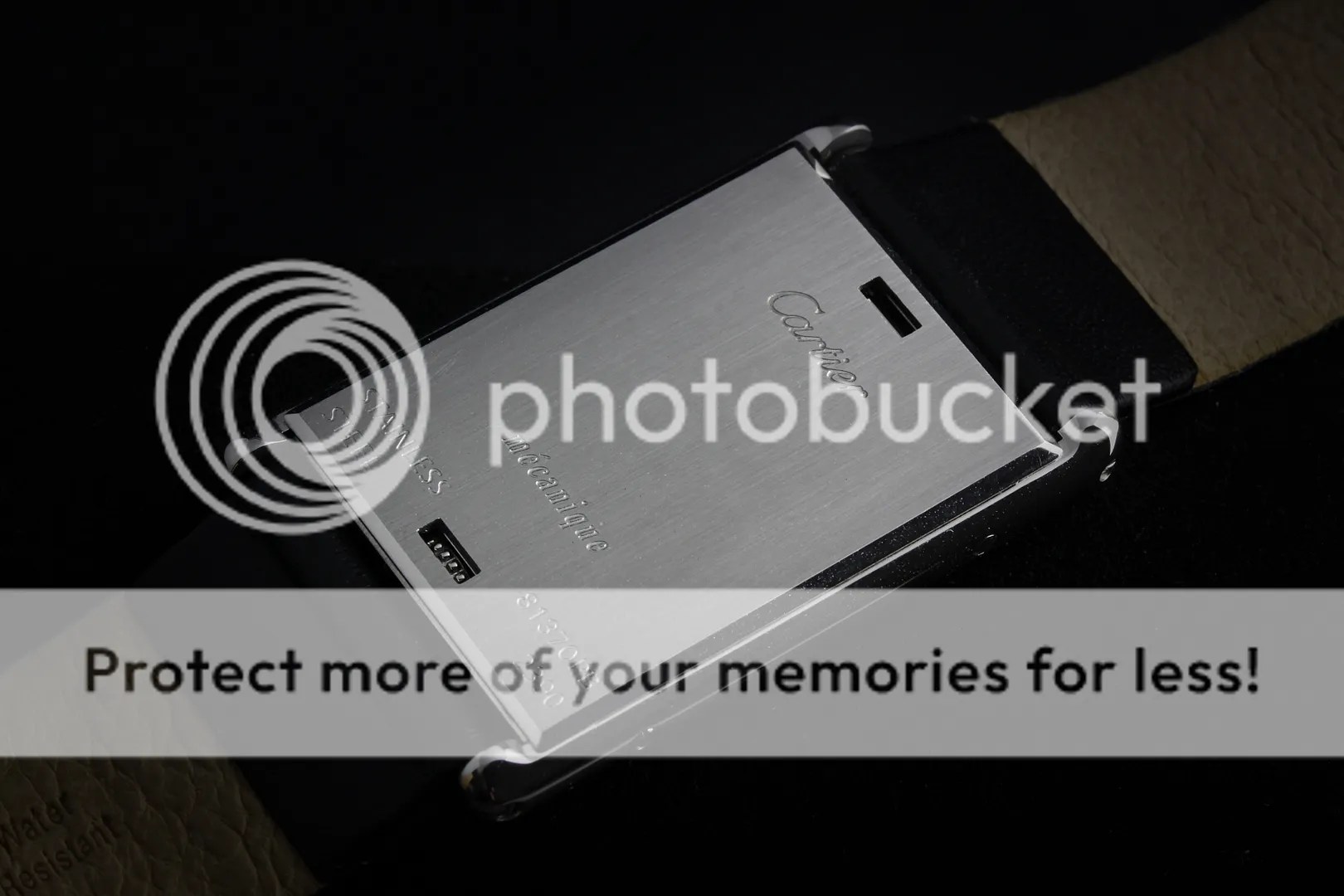
Basculante

Another long post warning!

There are some fairly strong views regarding what qualifies as a “WIS” brand amongst the various watch houses out there. Some very, very good watches seem to be regularly disparaged and many have suffered the ignominy of being labelled a “fashion brand” by those in the know. I’ve seen this said of Cartier many times, when in fact nothing could be farther from the truth.

Founded in Paris, France in 1847 by Louis-François Cartier, the company actually remained under family control until 1964 and has been responsible for some iconic designs over the decades; think Panthère, Santos, Pasha and (of course) Tank and you begin to get the picture. In fact, it was way back in 1904 that the company took its first serious steps into the world of high-end watchmaking. Alberto-Santos Dumont complained that pocket watches were not reliable or practical (especially when travelling) and his close friend Louis Cartier took up the challenge of crafting a more reliable alternative. The Santos wristwatch was manufactured as a result, and believe it or not this is widely regarded as being the first men’s wristwatch to be produced. In 1907, Edmond Jaeger and Cartier signed a deal that saw Jaeger create the movements for all Cartier watches and the company established outlets for sales in Paris, London, New York, and St Petersburg. Then, in 1917, the Tank was first introduced; all three of these models, including the Tank range which was designed on the war machine of the same name, are still in production today although they’ve obviously been updated and improved since then.

Around the time that JLC were introducing the Reverso to the market (that is, the start of the 1930’s), Cartier first released the Tank Basculante. It was similar to the Reverso in that it had a mechanism built into the case to enable the watch face to be turned; unlike the Reverso, however, it was meant not for protection but instead for the watch to be angled on a bedside table so as still to be visible in bed. It was, purely and simply, a traveller’s watch. (In fact, I think I’m right in saying that Cartier’s design – dating back to 1926 – was the first of such reversible or tipping watches; there was competition in the shape of JLC and Universal Geneve, but both were beaten to the punch.)

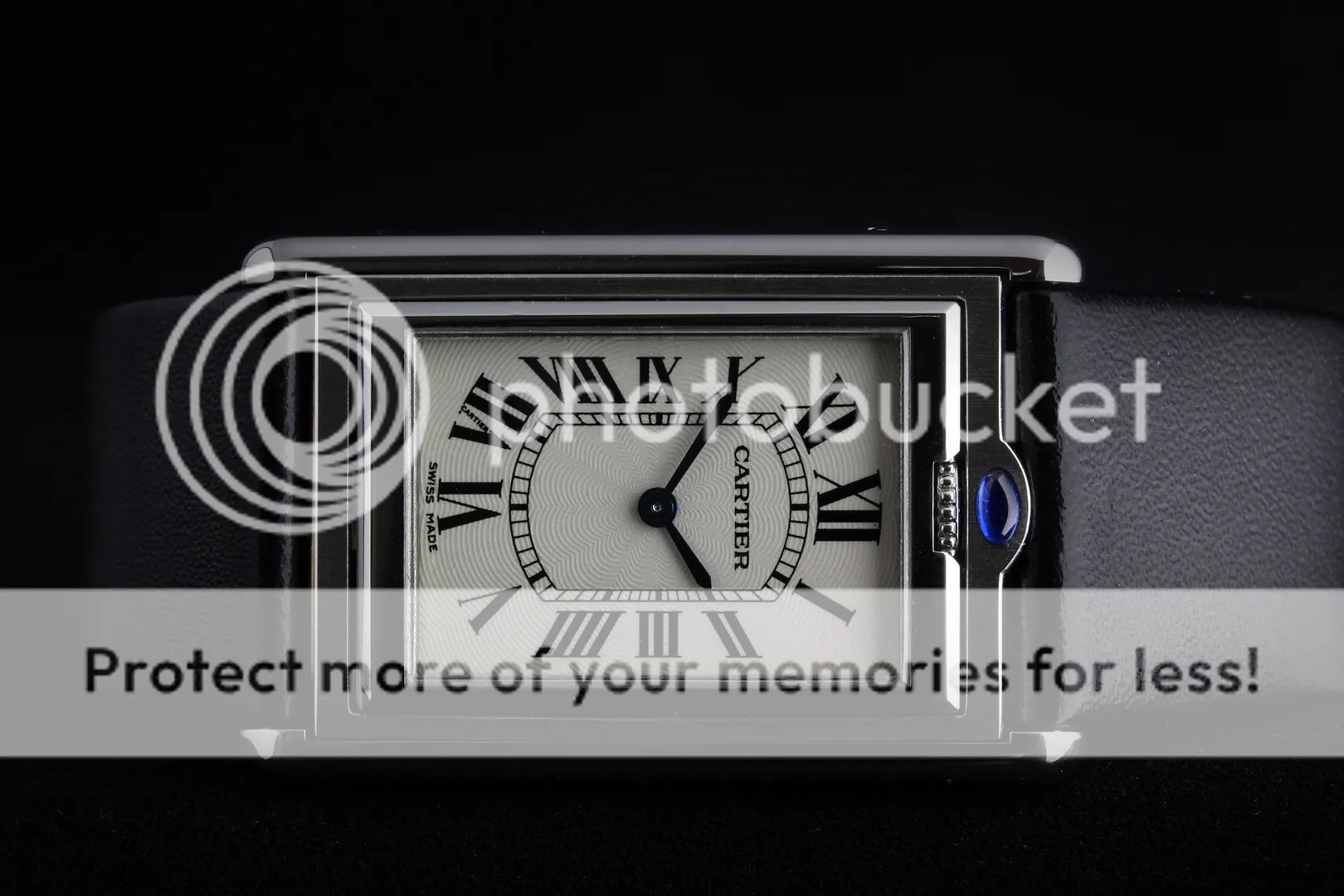
In it’s modern guise – which in any event is near identical to the original vintage pieces – the Basculante is quite simply a beautiful example of form and design. Featuring Cartier’s trademark guilloche dial with distorted Roman numerals and central minute track, it is simplicity itself; two hands, in the main no date and unmistakeable classic Cartier style. The case itself is engineering perfection, comprising three parts that are visually separated by satin brushed and polished finishes. At the top of the dial sits the crown, and above the crown a blue cabochon – another Cartier design trademark, matching the blued steel of the hands.

The case itself (at least in respect of the larger sized variant – there are smaller models too) measures 38mm by 25.5mm, a very wearable size for a man and relatively large in terms of a rectangular dress watch. The watch housing itself is mounted in a frame, which is then hinged at the lower end to the third piece of the case, the back. Within its frame, the watch case can pivot for reversing or angling. Amazingly, the complete case assembly is just 6mm thick.

To demonstrate that the Basculante is not simply a “fashion watch”, it contains a first-grade movement – branded by Cartier as their calibre 060 but actually made for them by Frederic Piguet (used by the likes of Breguet and Blancpain). At just 6.5 lignes (15.2 millimetres) and [I]2.1 millimetres thick[/I], the calibre 6.10 beats at 21,600 vph and uses 21 jewels. In fact, and in the words of Walt Odets, “it’s a much finer, much more sophisticated piece of work than Jaeger LeCoultre’s basic Reverso movement, the calibre 846.” For anyone interested Walt’s article can be read here, and part two contains some fantastic shots of the beautifully decorated movement.

Why did I buy the Basculante, I hear you ask? Well, my love of JLC is certainly no secret, and at some time or another a Reverso was the inevitable missing link to be added to the two that I have. However, when I stumbled across this Basculante (which dates to 2002, although it had a full service at Cartier in October of this year) it made me think, and I proceeded to do a little bit of research which only made me like it more. In fact, I think it’s a seriously beautiful watch, housing a seriously beautiful movement.

It’s also quite refreshing to go for something a little less mainstream than the norm. Cartier is a misunderstood brand in my opinion, and is worthy of more recognition than it receives. Yes, it’s a name associated with fashion and jewellery but it also has it’s own place in horological history and has a richer heritage than many that are lauded as being WIS-acceptable. In fact, some would say that the Basculante is the real WIS model within the Cartier range, with an undoubted heritage and history behind it.

Sub standard

Nylons?

The “other” JLC

I forgot just how perfect the RDM really is.

Friday afternoon watch porn

Perpetual

McWho?

Life can be…

Red, white and black (kind of…)

Dial R for Rolex

Dial

As good as it gets?

Long post warning!

Complications. They seem to divide opinion to a certain extent, in as much as some of us love them whereas others prefer the simplicity of a more basic mechanism and, consequently, dial. For me, it’s been a strange morphing of taste over the last year or so although I have to admit that my interests seem to be rooted firmly in two camps. (Well, why does a liking for simplicity or complexity have to be mutually exclusive?)

I’ve owned a JLC Reserve de Marche for quite a while now, and it really is one of the most perfect of watches. Whilst the dial has a fair amount going on the overall appearance is one of simplicity. Ironically, I thought that it was pretty much the limit for me when I bought it but before very long I realised that – if anything – I hadn’t gone far enough, and I was soon mulling over various options for even more complication, particularly the strangely alluring moonphase. In fact, the mulling soon became a yearning; I’d been looking at vintage options (such as the Universal Geneve Tri-Compax) for quite some time – months, in fact – but I ended up firstly with a Seiko Spring Drive Moonphase and then a GO Senator Lunar Reserve de Marche. (As an aside, the moonphase is the strangest of complications, isn’t it? No use whatsoever, but so beautiful.)

Both were fine watches, but for some reason neither seemed to feel like they were “one” I was looking for, and it slowly dawned on me that the watches I was continuously salivating over were those that really seemed to push the watchmakers art closer to the boundary. In fact, what I really wanted was a Perpetual Calendar; specifically, the JLC Master Perpetual that was discontinued quite a few years ago now but which – at 37mm – was a far better size in my eyes than it’s larger replacement (the current 8 Day Perpetual).

I went as far as to post about the watch quite a few times on various forums over the months, particularly when chewing the (two or three-dimensional) fat with the like-minded friends, but to be entirely honest I had far from made up my mind that I was actually going to buy one any time soon. Then a few wheels seemed to turn in the horological universe such that circumstances presented me with the opportunity that I’d been (almost) waiting for. Today, as a result, a JLC Master Perpetual Calendar in rose gold arrived as promised and I can finally say that I have a watch that leaves me without any further desire, for anything. Well…

The movement is the Jaeger LeCoultre Calibre 889/440/2, which dates back to 1996. It’s actually the JLC 889/2 base movement, with then utilises the design of the IWC perpetual calendar plate made famous by that company in the Da Vinci (although from what I understand the movement in it’s entirety, including the calendar plate, is manufactured by JLC).

It’s a 28,800bph automatic movement, with 50 jewels, and 277 parts. Like all movements used in the JLC Master Control series, it’s been subjected (as a completely finished watch) to 1000 hours of rigorous reliability testing in 6 positions, over a temperature range of 4->40 Celsius. Testing includes magnetism (5000 amperes/meter), shock, vibration, and pressure (5 atm) tests.

In terms of functions, there really is quite a lot going on.

  • Hours, minutes and centre sweep second hand
  • Date, month and day of week each on separate recessed sub-dial, with blued hands.
  • Two digit year display, via a window within the month sub-dial
  • Moon phase (yes, you may well ask why, and there’s no answer other than “because”)
  • A warning indicator, just below the month sub-dial, which shows red during the time period (10pm->3am) when it’s unsafe to set back the time, or adjust the date. (The hands even have cut-outs in them so that the indicator is visible at all times.)
  • One pusher, which adjusts (in a single operation) the entire calendar (date/day/moon phase/month/year simultaneously) one day forward per push.
  • With regard to that latter point, I think this is known as a “locked” calendar mechanism, and the alternative isn’t something that would be particularly user-friendly. However, the calendar can’t be turned backwards; this means that if you were to inadvertently set it ahead of the current date all you can do is let it wind down until time has caught up with the representation of time… (that was just for you, Cilla).

    The case is simply gorgeous, a warm, soft pink 18kt rose gold (the diameter 37.2mm, height 10.1mm). It has a very slightly domed crystal and solid case back, which is attached to the case with 4 screws. This beautiful watch was also available in stainless steel, yellow gold and platinum and to my knowledge all provided the option of bracelet or alligator strap with appropriately matching deployant. (I have to ask, though, who on earth would wear this on anything other than leather?)

    Anyway, that’s about it. For me, it’s just the fulfillment of a bit of a dream, albeit a relatively recent one, and something I can’t imagine topping (or even thinking of topping), and suspect that I’ll be wearing this quite a lot. To put it mildly!

    Luminiscious

    Size isn’t everything

    This is such a lovely watch. At 37mm the size is spot on for something dressy, but it’s equally nice with jeans and a t-shirt. One of my all-time favourites.

    A scanner darkly

    It’s… complicated

    GO figure (II)…

    Classic

    Red Tuesday

    Regrets… I’ve had a few

    This isn’t one of them, though 🙂