Guest post – Carl’s vintage LeCoultre

Well, after a bit of a delay (sorry for that – life took over) I’m delighted to publish another guest post – this one from my mate Carl (“Feelingtheblues” on The Rolex Forum) in which he muses about his gorgeous vintage LeCoultre from the 1940’s. Thanks, Carl!

Vintage Watch Review: 1940’s Jaeger-LeCoultre manual winding watch in stainless steel

Since its creation in 1833, Jaeger-LeCoultre has been a synonym of haute horlogerie and high quality timepieces. For some, this may be nothing more than mere marketing and many would be able to say the same about a lot of other brands but in my humble opinion there is an important detail that makes it different if compared to others… Jaeger-Lecoultre is not only a company, it’s a manufacture of watch movements.
Same thing, different name? I would beg to differ! With about 1 200 calibres and 400 patents, the manufacture has played a very important role in watchmaking, whether we are talking about technological advances or performance increases. Surprisingly, despite its collaborations with Patek Philippe, Cartier and many other brands (to which it has sold a great amount of movements and ébauches), it seems like this name isn’t one that comes to the mind of enthusiasts when we talk about collectibles (unless we are talking about a Reverso from the 1930’s, some Grandes Complications or an original Memovox Deepsea). A lot of those watches can be found on Ebay, especially the LeCoultre’s sold to the American market, and with a bit of patience one can get a pretty good deal on them.

My Watch

There are some of those purchases that, even if you had been thinking about them, just seem to come up and surprise you. In all honesty I have to say it’s exactly what happened with this one! I had read about Jaeger-LeCoultre and learned a lot of things that made my watchmaking student self admire the name but didn’t really get into shopping for one. It was quite a good timing that, upon lurking ads on a watch forum, I came across one selling a small model in stainless steel and decided to let curiosity get the better of me.

The first thing that I noticed was, obviously, the dial; a champagne-coloured, very simple round one with applied arrow markers and Arabic numerals for the four quarters that match the gold coloured hands. Not only was the contrast with the stainless steel mesmerising but the patina that had developed on it made the whole face of the watch look a tad darker. I found that the watch had aged very beautifully and that the minute ring, along with the brand name (the shortened form of which indicates that this watch had been made and sold for the European market), remained very crisp looking; I had been warned by the seller that it may be an old refurbishing job but under my loupe it didn’t look like it. Alas, it happens that such information gets lost as the watch goes from one owner to another so I cannot confirm that the dial has never been touched or that the case and lugs have not been polished, but as far as I’m concerned if such things were done to the watch they haven’t ruined it like many other poorly done jobs I’ve seen around.

The 32mm round and mirror finished case would make a lot of people cringe; nowadays this would be considered a woman’s size but one could be surprised as I know a lot of ladies who would prefer to have a bigger timepiece on their wrists. Some would be able to settle down to such a size should the case be a cushion style as the corners would make it wear bigger but neither its shape nor its very small crown help this timepiece to look bigger. Yet, this is one of the things that made it ever so attractive to me. Its elegant and subtle size makes it a wonderful dress watch as well as a good size for a casual one (in my humble opinion, of course), the wrist surrounds it in a beautiful way and in my mind there’s no doubt that this is a vintage man’s watch. You may also notice the tear drop lugs, a classic among details on Jaeger-LeCoultre’s watches.

There’s no doubt that the external look of the watch is a very important thing to look at when shopping, however, in this case the interior of the watch was just as important to me. I have many lower end timepieces that I have bought because I found them beautiful but for this one I knew that I was also getting a well built and beautifully finished movement. The brass bridges make the whole movement pop out when you open the case back and their finishing is outstanding: côtes de Genève stripes, beveled edges and elegant yet sharp forms… everything makes you think that they’ve paid a lot of attention to details whilst producing this calibre.

All in all, for a lot of people this watch would look like a mere small accessory made to tell time, this is something that made this watch a great purchase to me. Its simplicity makes it an elegant timepiece, yet, as a vintage watch enthusiast and as a fan of companies with a great historical background, the gears and parts inside this small case make me understand why Jaeger-LeCoultre is such a respected brand in the world of haute horlogerie and make me want to fully agree with that statement. To me it’s more than having a watch with a fancy name, it’s knowing what this name really represents, whether a lot of people know it and agree with it or not.

So there I was…

…Sitting at home the other night giving myself a pat on the back for finally getting down to my target of 6 watches (not bad, considering I’d been on 17 just a few months ago). Anyway, I got to thinking about the ones I missed – not that high a proportion, considering I’ve flipped so many – and one of those that sprung to mind was my old Speedy “Grail”.

Now, I missed it partly for the lovely watch that it was but also because inside was the veritable Lemania 5100 movement, which in itself is more than a little interesting. It was the successor to the 1340/1341, which had been in production since 1972 or thereabouts, and was developed in order to provide a cost-effective alternative to the cheap quartz movements that were flooding the market at the time. The 5100 wasn’t innovative in any way (in fact, it’s considered somewhat antiquated) and it was actually made with one or two nylon parts – for example, the clutch wheel – as well as iron bearings in place of certain jewels that would otherwise have been used.

It was quite simply a rugged workhorse of a movement, but whilst it gained respect for that, the main reason that it has become so lauded over the years is because it offers a different and rather brilliant take on the chronograph functionality. Underneath the main chronograph hand is another (aeroplane-tipped) hand that actually traverses the dial counting off elapsed minutes; this is much easier to read than a sub-dial, and it means that there is only one chronograph-related sub-dial, that being the elapsed hours (at 6). At 9 is the sub-seconds and at 12 is a 24-hour register. Very different, very useful and very readable.

So, back to the other night, then, and I started off thinking about the Speedy and its movement. That got me thinking about the Ed White in my collection at the moment, with it’s rich history and heritage in terms of the space programme. And that’s when I had an epiphany, because I was bloody sure I recalled that there was also a Sinn that was used during the early years of the space programme, and which also used the L5100 movement. A few minutes of research, and I had identified the watch concerned – the Sinn 142.

This is actually an interesting watch. It was once thought to have been the first automatic chronograph in space, and indeed subsequent case backs were so engraved. However, that honour actually went to the Seiko “Pogue” 6139-6002, which spent a few months on the wrist of Colonel William Pogue aboard Skylab 4 in 1973. (Incidentally, although a lot of people believe that the L5100 was first used in 1978, from what I can gather it was actually developed for Omega in 1973, and used in the Speedmaster from the following year.)

Anyway, the Sinn 142 was worn – as the second automatic chronograph in space – by Reinhard Furrer aboard the Space Shuttle Challenger in 1985. Mission STS 61-a (also known as D1… remember that) was the 22[SUP]nd[/SUP] space shuttle mission, and was the last successful mission of the Challenger, which was destroyed during mission STS-51-L in 1986. STS-61-A currently holds the record for the largest crew, eight people, aboard any single spacecraft for the entire period from launch to landing.

So, those were the sparks in terms of both the movement and the watch that prompted me to post a “Want To Buy” ad the other day for a L5100-powered Sinn 142. No sooner had I posted it, than I had a message from a friend of mine saying that he’d actually just listed one for sale. Within minutes a deal had been done and a couple of days ago the watch landed on the doormat (well, I opened the door to the postman and carefully relieved him of the package). There are a few interesting things about this watch too.

Firstly, it carries the number 1420008 on the caseback. Bearing in mind the caseback is engraved with the D1 mission logo it doesn’t seem possible that it can be one of the earliest examples as this engraving only occurred after 1985 for obvious reasons; it also has the newer dial variant. Anyway, I’m waiting for Sinn to clarify the meaning of that number and hopefully all will be revealed shortly. The other interesting thing (but only for me, I imagine) is that it’s not mint, and shows very obvious signs that it’s been used as intended over the years. I’m currently trying to wean myself off only perfect and mark-free examples of older watches in order that I can wear them without worrying about them all the time. It remains to be seen whether or not I’m successful 🙂

Return of the 5513

Not too long ago I was rejoicing the absence of divers in my now relatively small collection, having just moved on my second Great White in favour of a white gold Zenith Daytona. In fact, in the past I’ve had two of those beauties as well as two of the nicest 5513s that I’ve ever seen, not to mention a near perfect 1680. I suppose I’ve enjoyed something of a love affair with vintage Rolex divers and for some reason I’d decided that it needed to come to an end; in part, I suspect it was because I was a bit uncomfortable having so much money invested in a tool watch (at least, so far as the 1665s were concerned) which then made me worried about wearing them in all but the safest environments.

Anyway the upshot was that I tried to buy back my last 5513, unsuccessfully it transpired, and then set my sights on finding another really good example. At the same time, a TZ-UK member with whom I’d dealt before dropped me an email asking if I’d be prepared to let him have the Daytona and suggesting that I might want – you’ve guessed it – his 5513 in part trade. Well, a long exchange of emails transpired, but finally we got to the position where a deal could be done; yesterday, after a long wait, my 5513 arrived.

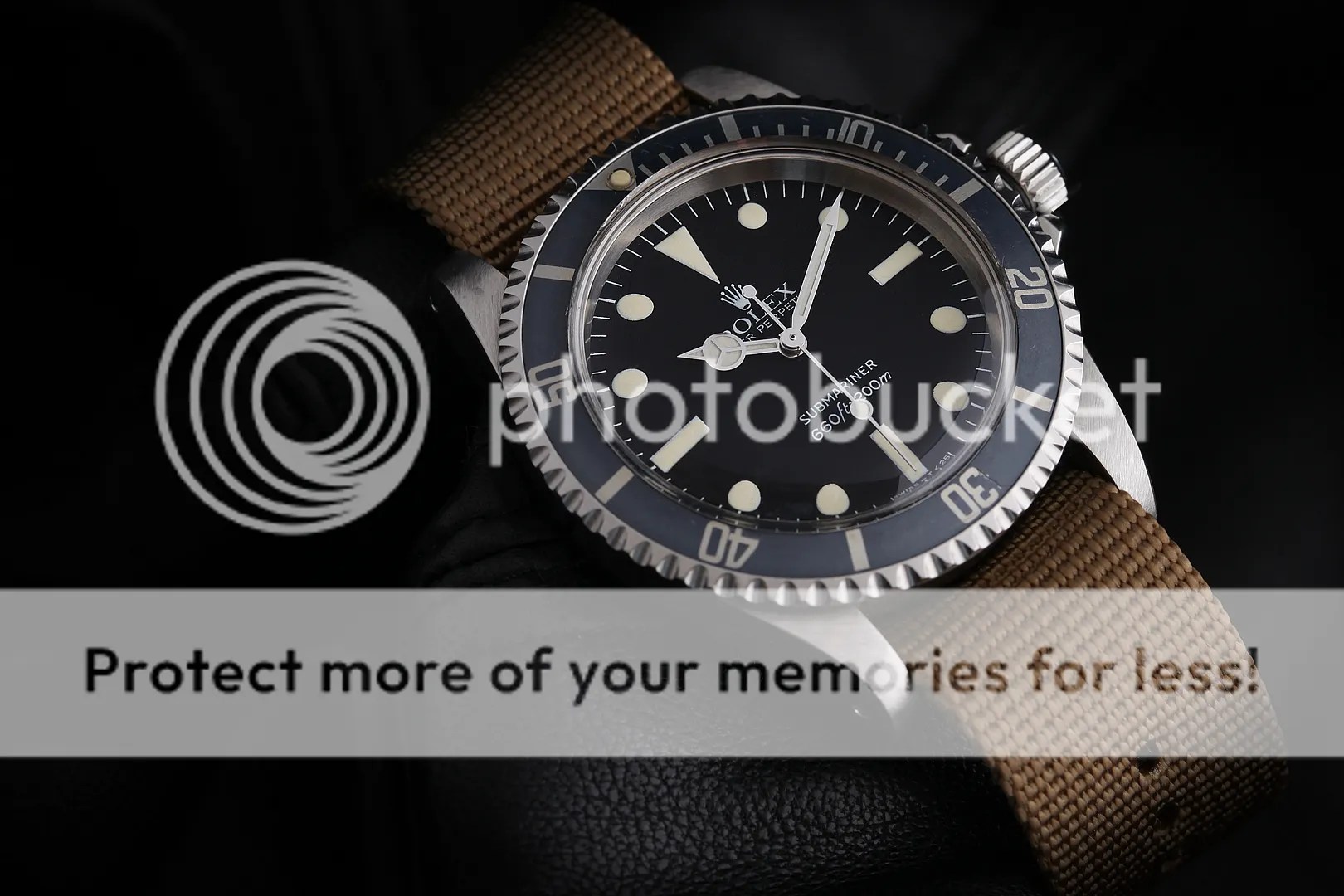
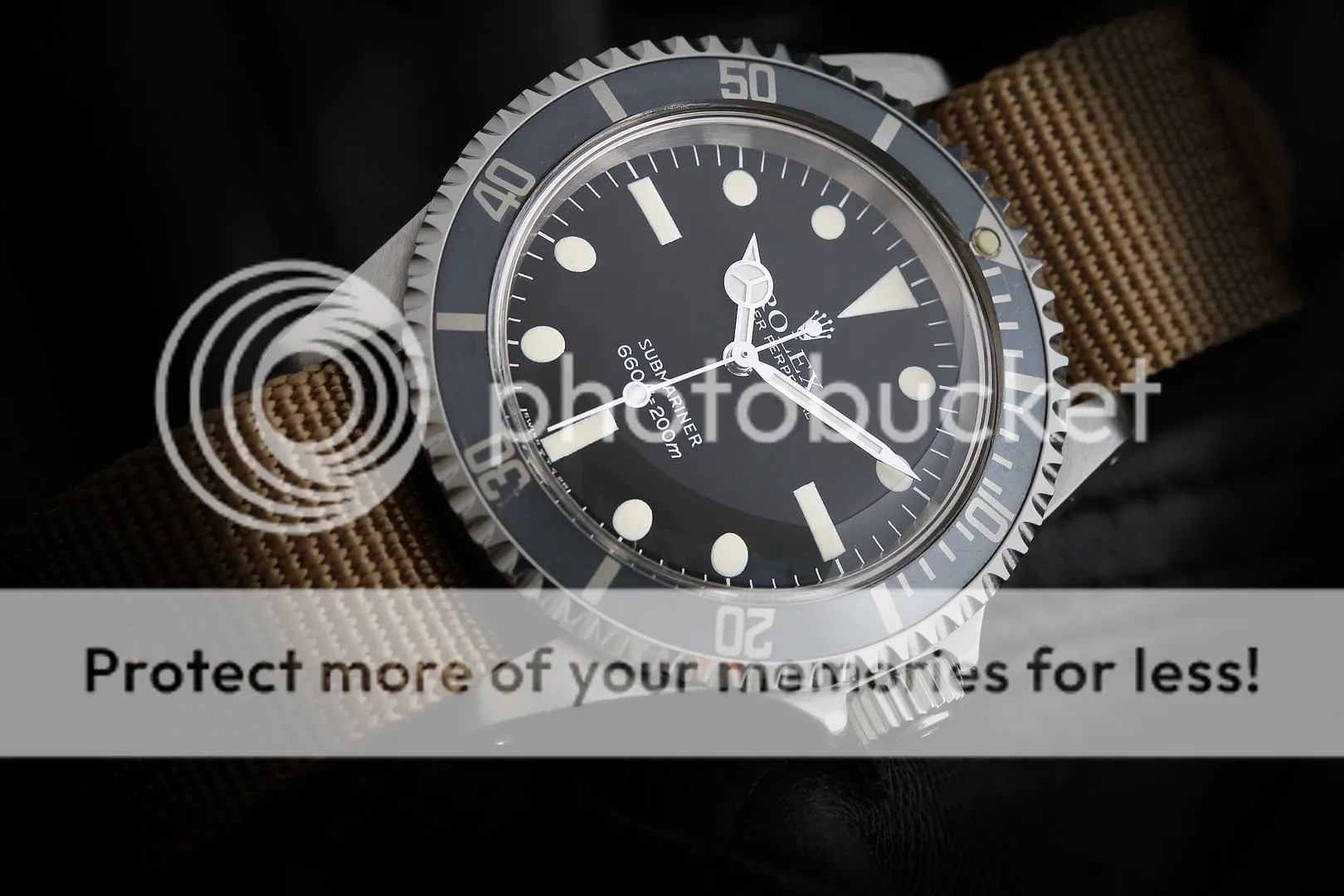
This watch dates from 1981, and benefits from a NOS Tropic 19 Superdome crystal as well as a period-correct NOS 93150 bracelet. The dial is perfect, with gorgeous lemon-coloured plots and the hands are absolutely free of any corrosion (the flash makes them look a little bit lighter than the plots but in reality they’re a perfect match in terms of colour). It’s actually a Mark IV maxi dial, for anyone interested. Aside from the serial range being a pointer it’s recognisable by the sans serif font, the size and position of the plots and the relative positioning of the bottom text (and specifically the “=” symbol). It also has a beautifully faded fat font insert, which whilst being a little early to be absolutely correct for the watch gives it an appearance that I think is quite sublime. Aside from that, it has a really fat case and lugs, which means I don’t have to worry too much if it picks up some marks and consequently needs a tart-up at some point in the future.

Anyway, I’ve now reverted to my two non-Rolex dressier watches in the JLC and the GO, and certainly won’t be making the error of moving the 5513 on again in the future. If once is careless and twice is foolhardy, three times would be downright stupidity.

My 2nd Cartier

I have a lot of respect for Cartier as a manufacturer of watches, and some may remember a post I wrote in November 2012 after I bought a Tank Basculante, in which I made those feelings clear. That was a gorgeous watch but proved to be a tad small for me, and ultimately it had to make way for a Reverso that I’ve been enjoying for many months now.

Anyway, I’ve been looking at the Santos for some time as a possible replacement, and yesterday I was offered one in mint condition and at a good price so decided to give it a go. I’m very impressed actually, as the quality and finish are superb. It’s the 100 XL, and whilst a large watch the curved case and relatively short lugs mean that it sits perfectly on my 6.75″ wrist. In fact, the case without the lugs and crown guards only seems to measure about 38mm square, which is slightly smaller than the 41mm quoted on the net (either way, it’s nowhere near as big as I thought it would be). The movement is an ETA base, the dial a traditional Cartier Roman numeral non-date, and the mix of polished and brushed surfaces gives it an appearance that’s both sporty and dressy.

Was the Santos the first ever wristwatch? Possibly – it’s a bloody good story anyway, though!

A lesson in vintage

These two watches have taught me a very important lesson when it comes to vintage, and one that has altered my whole perception of what I like. I’ve spent the last couple of years looking for old watches that are so pristine that they might never have been worn, but throughout that time I’ve been missing the point.

I love these watches so much, and part of the reason is that wearing them feels like I’ve inherited their history – because you can see that history at a glance. In fact, this has struck home to such an extent that I’ll almost certainly move on my NOS Autavia GMT and replace it with something that looks… well, a bit older.

Funny game, this.

This took me back

A while ago I was asked to take some shots for a jewellery website that’s under construction. The jewellery is bespoke and beautiful, and the designer actually made Bea’s engagement ring as well as our wedding bands.

Anyway, it had been a while since I’d shot any serious photos (although I’d never done anything like this before), and matters were complicated by the fact that when the lights that had been hired for me were unusable; I therefore had to shoot everything with natural light only, balanced on some precariously broken steps outside the French windows. Still, I was quite pleased with how they came out, bearing in mind I had to put up with shallow depths of field and shutter speeds that were in reality a little too slow!